
TIFF 2024, #6: “Conclave”, de Edward Berger
Há mais de oito séculos, a igreja católica escolhe o seu papa por meio de um ritual chamado conclave. Trata-se de uma eleição praticamente inalterada em regras e processos desde meados dos anos 1200, quando o Papa Gregório X usou pela primeira vez esse nome para definir o ritual. Atravessando eras e fatos históricos, o conclave, entretanto, ainda é uma formalidade cercada de mistérios, uma vez que segue sendo realizada a portas fechadas e com o máximo de sigilo. Em linhas gerais, o novo papa é eleito através de uma votação supostamente secreta entre os cardeais e deve ser citado por pelo menos dois terços das cédulas. A votação se repete até que o resultado seja alcançado, mesmo que ele demore apenas algumas horas ou até mais de dois anos para acontecer, como registrado nos conclaves mais curto e mais longo já registrados, respectivamente.
Particularmente, me escapa à memória alguma vez em que o cinema tenha investigado esse ritual de moto tão detalhado como em Conclave, novo filme do diretor alemão Edward Berger, amplamente reconhecido nos últimos anos com a nova versão que dirigiu de Nada de Novo Front, premiada com quatro Oscars, incluindo o de melhor filme internacional. Para imaginar o que acontece a portas fechadas no Vaticano durante a eleição do novo papa, Berger toma como base o best seller homônimo de Robert Harris, lançado em 2016. Transposto para o cinema, o texto se permite (re)criar conspirações, dilemas, dramas e até situações cômicas envolvendo a eleição papal, o que, ironicamente, acaba sendo o que não deixa Conclave alçar voos maiores diante de uma esmerada e suntuosa produção.
Assim como aconteceu em Nada de Novo no Front, o cineasta reúne um time talentosíssimo na criação técnica – e aqui podemos citar como exemplo desde alguns dos seus colaboradores frequentes, o compositor Volker Bertelmann, um mestre na criação de temas fortes e marcantes, ou novos que se juntam ao time, como Suzie Davis, que faz um trabalho imponente e requintado no design de produção. Conclave enche aos olhos, claro, pelo sofisticado trabalho coletivo, mas, principalmente, pela maneira como tecnicamente cria a atmosfera perfeita para que nós, fiquemos tão intrigados quanto deslumbrados com os cenários e rituais que a igreja católica tenta deixar longe do olhar público. A ostentação de tantas instalações grandiosas e figurinos meticulosos contribui para essa sensação de que há muita coisa acobertada — afinal, de onde uma instituição religiosa tira recursos para manter uma vida tão sofisticada e magnificamente emoldurada? Eis o mistério da fé.
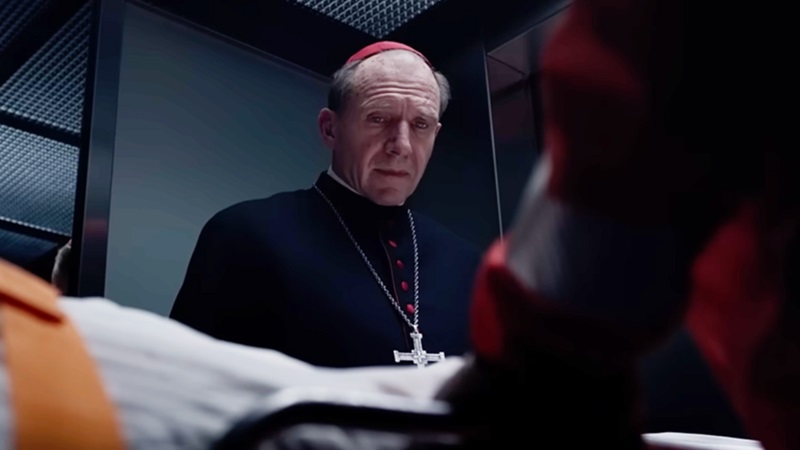
No centro da trama está o cardeal Lawrence (Ralph Fiennes), a quem é confiada a missão de organizar e intermediar um novo conclave. Não exatamente um ingênuo, ele traz a perspectiva mais apropriada para o longa porque se dá ao benefício da dúvida quando precisa administrar o meio de campo entre outros cardeais cujas crenças oscilam entre o conservadorismo intolerante e à busca por igualdade que desafia séculos de posicionamentos problemáticos da igreja católica. Se a religião é o pano de fundo, Conclave, por outro lado, entende que ela nada mais é do que um jogo político, no final das contas. À medida em que descortina passado e presente dos mais cotados para o posto de papa, Lawrence passa a compreender que, como diz o liberal cardeal Bellini (Stanley Tucci), tudo não passa de uma guerra em que é impossível não tomar lado. E mais: entre descobertas e traições, ele ainda se depara com a quebra da sua expectativa de que há uma pessoa ideal para o cargo. Assim como na vida real, todos carregam consigo erros, histórias acobertadas e fragilidades a serem atacadas como em uma campanha política.
Conclave arma seu tabuleiro de xadrez com admirável habilidade, mas, talvez seguindo à risca o livro no qual se baseia, peca na construção de diversos momentos que movimentam a trama. Não é lá muito natural como o longa encena a sucessão de revelações que dará cabo de vários nomes favoritos à eleição. Se os próprios acontecimentos já parecem desenhados apenas para trazer reviravoltas ao invés de aprofundar os personagens, o humor pontual de certas passagens também tira bastante da urgência almejada pelo longa, reforçando a impressão de que, vez ou outra, derrubar um outro cardeal está mais para a brincadeira do que para a plausibilidade. Por sorte, como o grande ator que é, Ralph Fiennes dá um show ao navegar pelas constantes transformações de um homem em conflito com a fé e com ele próprio. Se Conclave cambaleia, ele está ali para abrilhantar o dia — e para nos lembrar que, apesar das fragilidades nas resoluções, o filme de Edward Berger envolve e entretém.
CONCLAVE REVIEW
For more than eight centuries, the Catholic Church has chosen its pope through a ritual called the conclave. This election process has remained practically unchanged in its rules and procedures since the mid-1200s, when Pope Gregory X first used the term to define the ritual. Spanning eras and historical events, the conclave remains a formality shrouded in mystery, as it continues to be conducted behind closed doors and with the utmost secrecy. In general, the new pope is elected through a supposedly secret ballot among the cardinals, and he must be mentioned on at least two-thirds of the ballots. Voting is repeated until a result is reached, whether it takes just a few hours or over two years, as was recorded in the shortest and longest conclaves in history, respectively.
I can’t recall any other film that has explored this ritual in such detail as Conclave, the new film by German director Edward Berger, who has gained widespread recognition in recent years for his adaptation of All Quiet on the Western Front, which won four Oscars, including Best International Feature Film. To imagine what happens behind the closed doors of the Vatican during the election of a new pope, Berger bases his film on Robert Harris’ 2016 bestseller of the same name. Adapted for the screen, the story indulges in (re)creating conspiracies, dilemmas, dramas, and even comic situations surrounding the papal election. Ironically, it’s this element that prevents Conclave from reaching greater heights, despite its meticulous and lavish production.
As with All Quiet on the Western Front, the director has assembled a highly talented technical team. Among them are frequent collaborators, such as composer Volker Bertelmann, a master of creating powerful and memorable themes, and new members like Suzie Davies, who delivers an imposing and refined production design. Conclave is visually striking, thanks to this sophisticated collective effort, but even more so because of how the film skillfully creates the perfect atmosphere for us to feel both intrigued and dazzled by the settings and rituals the Catholic Church strives to keep hidden from public view. The opulence of the grand sets and meticulous costumes adds to the sense that much is being covered up – after all, where does a religious institution find the resources to maintain such a sophisticated and magnificently framed lifestyle? This is the mystery of faith.
At the heart of the story is Cardinal Lawrence (Ralph Fiennes), who is entrusted with the task of organizing and mediating the new conclave. Not exactly naive, he provides the most appropriate perspective for the film, as he harbors doubts while trying to navigate between other cardinals, whose beliefs range from intolerant conservatism to a quest for equality that challenges centuries of problematic stances within the Catholic Church. Though religion serves as the backdrop, Conclave sees it as nothing more than a political game, in the end. As Lawrence uncovers the past and present of the top contenders for the papacy, he begins to understand, as the liberal Cardinal Bellini (Stanley Tucci) puts it, that it’s all just a war in which it’s impossible not to take sides. Moreover, through discoveries and betrayals, Lawrence is forced to confront the fact that there is no ideal candidate for the role. As in real life, everyone carries with them mistakes, hidden stories, and vulnerabilities to be attacked, much like in a political campaign.
Conclave sets its chessboard with admirable skill, but perhaps by sticking too closely to the book on which it’s based, it falters in the construction of several key plot points. The way the film stages the succession of revelations that eliminate several frontrunners in the election doesn’t feel entirely natural. The events seem designed more to create twists than to deepen the characters. Furthermore, the occasional humor in certain scenes detracts from the film’s sense of urgency, reinforcing the impression that, at times, taking down a cardinal feels more like a game than something believable. Fortunately, Ralph Fiennes, as the brilliant actor he is, shines as he navigates the constant transformations of a man in conflict with his faith and himself. If Conclave stumbles, Fiennes is there to elevate it – and to remind us that, despite some weaknesses in its resolutions, Edward Berger’s film is engaging and entertaining.
TIFF 2024, #5: “Hard Truths”, de Mike Leigh
Poppy, a personagem irremediavelmente otimista de Simplesmente Feliz, teria muitos problemas caso esbarrasse com a Pansy de Marianne Jean-Baptiste em Hard Truths. Isso porque a protagonista do novo filme dirigido pelo veterano Mike Leigh é a antítese perfeita da protagonista criada pelo próprio cineasta em 2008. Se Poppy via o lado positivo de tudo na vida, Pamsy simplesmente não vê prazer em nada, o que faz de Hard Truths um Simplesmente Feliz às avessas, mas sem jamais parecer um mero espelhamento entre dois longas.
Com 25 títulos já dirigidos, Mike Leigh mergulha novamente no melhor de sua especialidade como contador de histórias: a franca observação de personagens tão comuns quanto profundamente humanos. Para tanto, ele volta a trabalhar com a grande Marianne Jean-Baptiste, que havia brilhado ao lado de Brenda Blethyn no célebre Segredos e Mentiras, alcançando notas cortantes para uma personagem das mais desafiadoras e que a dupla aborda com maestria.
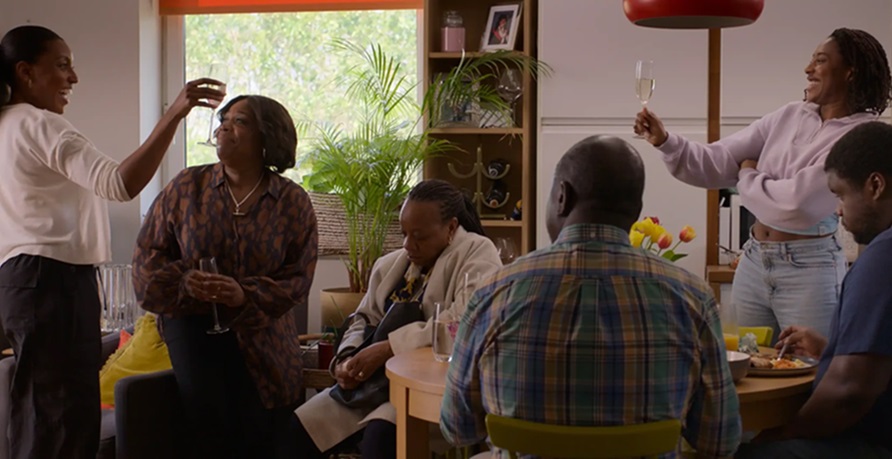
À primeira vista, Pamsy parece uma adorável rabugenta e sem paciência para perguntas óbvias, formalidades do cotidiano e firulas sociais. Ela não consegue sequer ir a uma consulta médica e ouvir um “tudo bem?” após um “bom dia”, pois logo dispara que, se tudo estivesse realmente bem, não estaria procurando ajuda. Pansy é como uma impiedosa metralhadora: não há qualquer pessoa imune ao seu temperamento, muito menos a própria família, do filho que ela despreza como um jovem sem futuro ao marido por quem também parece não nutrir afeto algum.
Hard Truths começa divertindo com a bruta honestidade da protagonista, mas Mike Leigh, também autor do roteiro, dá uma série de outros contornos para o filme — e todos bastante dramáticos. Em suma, o cineasta constrói um brilhante estudo de personagem sobre alguém incapaz de sentir qualquer prazer na vida, mutilando emocionalmente todos a sua volta. E talvez a maior vítima de Pamsy seja o próprio filho, que sequer consegue lhe entregar flores no dia das mães com medo do que pode receber como resposta.
O mal-estar causado pela personagem se torna ainda mais profundo quando Hard Truths investiga o quanto ela própria é vítima da sua maneira de se portar diante do mundo. Quando confrontada pela irmã, que tenta relevar seu jeito de ser e remendar o que está por trás de tanto rancor, Pamsy dispara, sem pensar duas vezes, que não sabe a razão de ser do jeito que é, como se admitisse que não há nada o que fazer em relação a isso. Fica visível, entretanto, o quanto a personagem se sente sufocada com isso — e o esforço descomunal que precisa fazer para colocar as flores do filho em uma jarra d´água mostra que palavras como sensibilidade e generosidade não fazem parte de seu vocabulário.
Marianne Jean-Baptiste surge magnífica na pele da protagonista em um trabalho que, repito, é dos mais desafiadores. Para além da questão de equilibrar as inflexões cômicas e dramáticas, a atriz precisa dar conta de no mínimo causar no espectador algum interesse na protagonista, já que ter simpatia por ela parece algo impossível. E ela consegue tudo isso: nas mãos de Jean-Baptiste, Pamsy é, sim, multidimensional, ao mesmo tempo em que desperta na plateia a mesma sensação de incômodo causada nos outros personagens em cena. Trata-se de um trabalho espetacular em tudo que se propõe.
Realista como sempre foi, Mike Leigh encontra o ponto exato para abrir o leque de emoções do filme sem tentar amaciar sua personagem. Não há concessões em Hard Truths, o que faz da sessão uma experiência densa e difícil. A recompensa, contudo, chega aos montes, com grandes atuações (Michele Austin também brilha como a irmã de Pamsy), roteiro maduro e a sólida direção de um cineasta que sempre tem algo de novo a dizer sobre a vida como a conhecemos.
HARD TRUTHS REVIEW
Poppy, the irredeemably optimistic character from Happy-Go-Lucky, would have many problems if she crossed paths with Marianne Jean-Baptiste’s Pamsy in Hard Truths. That’s because the protagonist of veteran filmmaker Mike Leigh’s new movie is the perfect antithesis of the character created by the director himself in 2008. While Poppy saw the bright side of everything in life, Pamsy finds no joy in anything, making Hard Truths the reverse of Happy-Go-Lucky, though it never feels like a mere mirror image between two films.
With 25 titles under his belt, Mike Leigh dives once again into the best of his specialty as a storyteller: the candid observation of characters who are as ordinary as they are deeply human. To do so, he reunites with the great Marianne Jean-Baptiste, who shone alongside Brenda Blethyn in the celebrated Secrets & Lies. Together, they reach cutting notes for one of the most challenging characters, which the duo masterfully tackles.
At first glance, Pamsy seems like a lovable grouch with no patience for obvious questions, daily formalities, and social niceties. She can’t even go to a doctor’s appointment and hear a “how are you?” after a “good morning”, as she immediately snaps back that if everything were fine, she wouldn’t be seeking help. Pamsy is like a ruthless machine gun: no one is immune to her temperament, least of all her own family – from the son she dismisses as a young man with no future to the husband for whom she seems to have no affection.
Hard Truths begins by amusing us with the protagonist’s brutal honesty, but Mike Leigh, also the screenwriter, gradually infuses the film with much more dramatic layers. In short, the filmmaker constructs a brilliant character study about someone incapable of finding any joy in life, emotionally mutilating everyone around her. Perhaps Pamsy’s greatest victim is her son, who can’t even bring her flowers on Mother’s Day for fear of her reaction.
The discomfort caused by the character deepens as Hard Truths explores how Pamsy is also a victim of her own way of interacting with the world. When confronted by her sister, who tries to understand her behavior and address what lies behind so much bitterness, Pamsy shoots back, without hesitation, that she doesn’t know why she is the way she is, as if admitting there’s nothing to be done about it. Yet, it becomes evident how much the character feels suffocated by this – and the enormous effort she must take just to put her son’s flowers in a vase of water shows that words like “sensitivity” and “generosity” are not part of her vocabulary.
Marianne Jean-Baptiste is magnificent in the role of the protagonist, delivering a performance that, I repeat, is one of the most challenging. Beyond balancing the comedic and dramatic nuances, the actress must at least spark some interest in the protagonist from the audience, as feeling sympathy for her seems impossible. And she succeeds at all of this: in Jean-Baptiste’s hands, Pamsy is indeed multidimensional, while also evoking in the audience the same discomfort she causes the other characters in the film. It’s a spectacular performance in every sense.
As realistic as ever, Mike Leigh finds the exact point to open the film’s emotional spectrum without softening his character. There are no concessions in Hard Truths, making the viewing experience dense and challenging. The reward, however, comes in abundance, with outstanding performances (Michelle Austin also shines as Pamsy’s sister), a mature screenplay, and the solid direction of a filmmaker who always has something new to say about life as we know it.
TIFF 2024, #4: entrevista com Fernando Coimbra, Thiago Thomé e Pêpê Rapazote sobre “Os Enforcados”
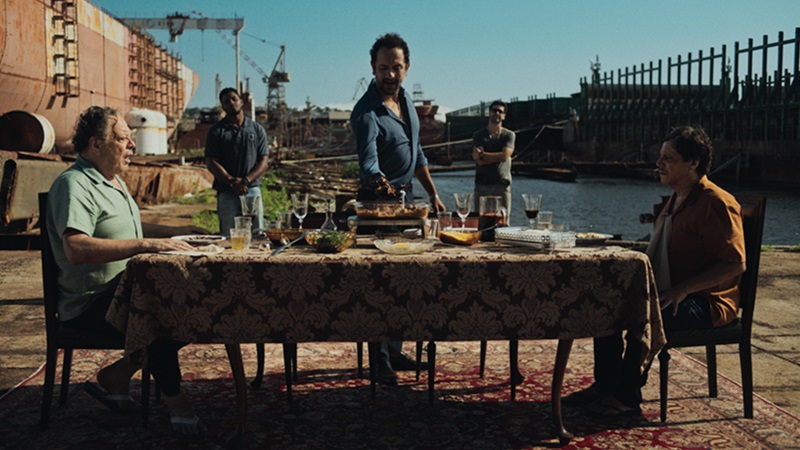
Mais de dez anos após o impactante O Lobo Atrás da Porta, pelo qual concorreu ao Directors Guild Awards de melhor longa-metragem de estreia, Fernando Coimbra está de volta com Os Enforcados, filme estrelado por Irandhir Santos e Leandra Leal que estreia mundialmente no TIFF 2024. A brutalidade volta a ser uma questão importante Coimbra, dessa vez na zona leste do Rio de Janeiro, tendo como pano de fundo a criminalidade do jogo do bicho e uma paranoia matrimonial que leva os protagonistas para uma espiral de impulsos, equívocos e violência. Diretamente do TIFF, conversei com o diretor e os atores Thiago Thomé e Pêpê Rapazote sobre os temas abarcacados em Os Enforcados e como o filme dialoga com a realidade brasileira e o próprio cinema de Coimbra. Confiram abaixo!
Fernando, sobre esse filme ser uma mistura de Macbeth com os irmãos Coen… Acho que ele será bastante interpretado dessa maneira. É uma definição que te agrada?
FERNANDO – Eu vendi um pouco o projeto desse jeito. Quando a gente começou a levar o roteiro pra fora, atrás de produção, foi assim: um Macbeth, inspirado nos irmãos Coen, com direção de um sul-coreano, passado no Brasil. Pra dar uma ideia do tom. [risos]
PÊPÊ – Aliás, a tradução quase foi No Country for Bicheiro, né? [risos]
FERNANDO – Tem uma inspiração de Fargo no roteiro, sim. Aquela ideia de “vamos cometer um crime, sequestrar alguém, pegar o dinheiro, ninguém se machuca e tudo vai dar certo”. Mas nada na vida real é o que se espera, né? A loucura das pessoas leva tudo para outro lugar.
O Lobo Atrás da Porta [primeiro longa dirigido por Fernando] abordava uma parte mais urbana do Rio de Janeiro. Agora, pelo que você falou ontem na sessão, a ideia foi pegar um outro lado do Rio de Janeiro. Essa “abrasileirada” da trama veio antes ou depois da ideia de misturar Macbeth com os irmãos Coen?
FERNANDO – Eu tinha mesmo a ideia de olhar para aquele lugar da Barra da Tijuca, zona oeste… É uma coisa que a gente não vê muito no cinema. O Lobo já foi um subúrbio do Rio, mas que não era a comunidade, não era a favela, também não era a Zona Sul.
THIAGO – A maior parte da população do Rio tá ali na zona norte
FERNANDO – Sim, e não se mostra tanto isso. E, quando mostra, tem um crime, envolve tráfico. Eu passava pela Barra, indo para algumas locações, e via que era um lugar a ser estudado. E aí eu tinha a ideia dessa história da máquina com a lei, jogo do bicho. Queria que os personagens estivessem inseridos em um universo criminoso. Criminoso, mas aceito. Até porque as pessoas estão tomando consciência do jogo do bicho só agora. Sabem que é uma contravenção, mas, na cabeça delas, não é um crime.
Pois eu ia perguntar especificamente sobre o jogo do bicho. O cinema brasileiro já falou muito sobre essas questões de criminalidade no Rio de Janeiro, mas você mesmo comentou que o jogo do bicho é uma coisa que ainda não tinha sido muito explorada. Isso passo um pouco por essa “ingenuidade” que é só um joguinho?
FERNANDO – Olha, é difícil dizer, mas eu acho que tem uma coisa muito folclórica do bicheiro, algo meio mitológico. E é, né? Eu cresci vendo o Castor de Andrade que parecia um personagem do Chico Anísio e que estava em todos os lugares. A presença do bicheiro foi completamente normalizada. É um jogo que nunca foi visto muito popularmente como um crime. Como esses caras ainda tem muita ligação com o poder, as coisas também ficam mais em evidência.
Tem, inclusive, aquela entrevista com o Zeca Pagodinho em que perguntam se ele é favor da legalização do jogo do bicho e ele diz: “mas é ilegal?”.
THIAGO – Eu, que cresci no subúrbio do Rio de Janeiro, lembro da minha avó que morava no Irajá. Ela fazia o jogo e dava pra gente ir lá levar no bicheiro. É muito cultural. E essa ligação com a escola de samba… A gente cresce já entendendo esse lugar. Então, faz parte. Tanto que essa fala do Zeca, não é uma parada que ele fala como comédia. É real. Ele fala com muita naturalidade. O que pode e o que não pode tem um limiar muito fino no Brasil. Algumas coisas não podem, mas são aceitas. Outras podem, mas não é legal fazer. A gente fica sempre nessa dicotomia do que pode ser feito e do que não pode. O jogo do bicho entra muito nesse lugar. Qualquer morador do subúrbio do Rio de Janeiro sabe onde estão os pontos pra jogar: na barbearia, no bar… A gente cresce sabendo. Claro, depois que você vai tomando consciência, você sabe que não é legal. E, aí, você faz a escolha de jogar ou não.
FERNANDO – É, mas eu moro em São Paulo, em Perdizes, e tem dois pontos do bicho perto da minha casa. Não é só no Rio.
Fernando, você mencionou a brutalidade que está envolvida em tudo isso. Nos teus dois filmes, tanto no Lobo, quando agora em Os Enforcados, a brutalidade está mesmo muito presente. Isso é coincidência ou é de fato um interesse do teu cinema?
FERNANDO – Não é coincidência, não. É realmente um interesse. Eu acho o ser humano muito brutal. Se você olhar para o que acontece em Israel, Gaza, Palestina, Rússia, Ucrânia, Estados Unidos… Mas é violência em vários níveis, desde as relações familiares mais básicas, que são agressivas e invasivas, chegando até vários níveis sociais. O ser humano é um bicho.
Era isso que eu ia mencionar. No filme, tem também a brutalidade psicológica e emocional entre aquele casal, e vocês dois [Thiago e Pêpê] estão no meio do fogo cruzado. Vocês exercem um papel muito importante ali nessa dinâmica de que “o que os olhos não veem, a paranoia inventa”.
PÊPÊ – Você tem razão. O que os olhos não veem, a paranoia inventa. Fica a sugestão, sobretudo quando você já está desconfiado. Qualquer sinal já entra na paranoia. E eu acho que o papel do Thiago e do Delegado Torres [papel de Pêpê] são os contrapontos que permitem a subida vertiginosa da paranoia, da esquizofrenia desse casal, diante da falta de comunicação, de uma separação.
THIAGO – Acho que, no caso do Jobson [papel de Thiago], viver ali com aquela família acaba fazendo ele entender, pensar que “faz parte”. E a gente vive isso na nossa vida. Tem coisas que eu vou olhar na sua vida e falar assim: meu Deus, como é que você faz isso? E, aí, você vai olhar pra mim e falar a mesma coisa. A gente aceita porque é uma intimidade. Cada um vai ter um ponto de vista. Acho que, nesse sentido, o Jobson não julga. Ele sabe, ele vê, mas não vai julgar, porque ele vive com esse cara [o personagem de Irandhir Santos] desde sempre. Ele olha aquilo e fala: faz parte da família.
PÊPÊ – E, no caso do Delegado Torres, ele está habituado a muita coisa. Só quer descortinar.
FERNANDO – É um filme sobre um casamento. E o casamento é um pacto. Um pacto de vida. E um plano. No começo você fala: vamos casar, ter filhos, uma casa no campo. E, ali, é meio isso, mas num lado mais alegórico: o crime é o plano. E é uma coisa simples. Descrição de Fargo, né? Como em muitos casamentos e em muitas relações, de repente, eles começam a não querer compartilhar, ele vai se empoderando…
PÊPÊ – A paranoia inventando coisa, né? Ele já não precisa tanto dela, vai perdendo as rédeas um pouco. Ela não se sente cúmplice, mas, sim, secundária em um determinado momento. E o Delegado Torres é como um amante, aquela terceira pessoa que, quando a relação não está bem, chega e fala: “vem cá, tem uma vida melhor te esperando”. Tinha que ser uma coisa meio assim. E acaba sendo outra fantasia criada: a de sair da relação e ter outra pessoa trazendo um caminho melhor, de salvação. Acho que a ideia era trabalhar muito nessa coisa que eu acho que corresponde em todo mundo: as relações humanas.
Pegando o gancho dessa discussão, quero entrar na questão do tom propriamente dito do filme. É uma mistura de thriller, comédia, drama… E é claro que um diretor vai trabalhando para que todas as peças de encaixem, mas, no caso de um projeto que mistura várias coisas como Os Enforcados, a gente só vai saber mesmo se todas as peças se encaixaram no final, quando o filme fica pronto e chega ao público. Como foi para você, Fernando? Isso de alguma forma te intimidou? Ou foi algo estimulante?
FERNANDO – Intimidou, mas, na verdade, foi me colocando em um lugar totalmente fora da zona de conforto de tudo que eu vinha fazendo. Eu queria que o filme tivesse essa coisa meio pesadelo, meio alegórica também, no jeito de contar. Então, não é naturalista como o Lobo era. Não me intimidou. Me deu foi muita coragem de fazer. Mas é bem o que você falou: fica esse mistério.
THIAGO – As transformações estavam muito bem pontuadas para simplesmente não perdermos a linha. Tem uma coisa também da construção desses personagens que o Fernando criou. Nós, como atores e atrizes, também precisamos conceber e passar a credibilidade de que são humanos. Eles podem ter esses vários planetas dentro do mesmo universo. E o Fernando consegue escrever isso de uma forma brilhante, dando essa liberdade para sermos o que somos mesmo. O filme trata isso muito bem. Tanto que as pessoas riram, aplaudiram.
E a risada, no fundo, sempre esconde uma coisa na qual as pessoas se reconhecem, né?
PÊPÊ –Total. Eu brinco com o Fernando que esse filme é uma forma de jogar para fora o psicopata que fica aí dentro. Esse filme só existe porque o Fernando não está preso. [risos] A reação de risada é a mesma coisa. É rir de uma coisa que estava querendo rir faz tempo. Com relação ao tom que a gente estava falando, tem também essa saída e entrada do pesadelo, com personagens sempre se puxando pra um lado e pro outro. E isso, pra mim, era no início: “caramba, que insegurança que é essa? Onde que eu estou?”. O meu sofrimento só era apaziguado pelo sofrimento do Fernando. Se eu estava assim, imagina o Fernando que pensava em todas as personagens? Tinha tudo isso, mas ficou no ponto certo, equilibrado. Parece um milagre, só que não é um milagre. Tem muita sabedoria.
E trabalharam bastante pra isso. [risos]
THIAGO – Uma coisa boa de pontuar, só pra poder finalizar, é a leveza que foi construir esse filme. O set, a liberdade que o Fernando deu pra gente atuar. Quando a direção escolhe um elenco, dá pra entender que ele escolheu aquele ator, aquela atriz, para aquele papel. Ela sabe da competência daquela pessoa. E o Fernando não é um diretor que interfere tanto, sabe? Ele diz: vai lá e faz. Isso torna o set leve, e um set leve faz um filme ficar brilhante. Ajuda muito. Pra não ficar todo mundo…
Na paranoia dos personagens? Fazer a coisa mais leve.
THIAGO – Isso.
Os Enforcados abre a Première Brasil do Festival do Rio no dia 4 de outubro e tem estreia programada no circuito comercial brasileiro para o dia 21 de novembro.
CARNIVAL IS OVER: INTERVIEW WITH DIRECTOR FERNANDO COIMBRA AND ACTORS THIAGO THOMÉ AND PÊPÊ RAPAZOTE
More than ten years after A Wolf at the Door, for which he competed for the Directors Guild Awards for best debut feature film, Fernando Coimbra is back with Carnival is Over, a film starring Irandhir Santos and Leandra Leal that has its world premiere at TIFF 2024. Brutality once again becomes an important issue in Coimbra, this time in the east zone of Rio de Janeiro, discussing the criminality of Jogo do Bicho and a marital paranoia that leads the protagonists into a spiral of impulses, mistakes and violence . Directly from TIFF, I spoke with the director and actors Thiago Thomé and Pêpê Rapazote about how the film dialogues with brazilian reality and Coimbra’s own cinema. Check it out below!
Fernando, regarding this film being a mix of Macbeth and the Coen brothers… I think it will be interpreted that way quite a bit. Does that definition appeal to you?
FERNANDO – I kind of sold the project that way. When we started pitching the script, looking for production, it went like this: a Macbeth inspired by the Coen brothers, directed by a South Korean, set in Brazil. To give an idea of the tone. [laughs]
PÊPÊ – By the way, the translation almost became No Country for Bicheiro, right? [laughs]
FERNANDO – There’s definitely some Fargo inspiration in the script. That idea of “let’s commit a crime, kidnap someone, get the money, no one gets hurt, and everything will work out.” But in real life, nothing ever goes as expected, right? People’s madness takes things in a completely different direction.
In A Wolf at the Door [Fernando’s first feature film], you explored a more urban side of Rio de Janeiro. Now, from what you mentioned in the screening, the idea was to explore a different side of the city. Did this ‘Brazilianization’ of the plot come before or after the idea of mixing Macbeth with the Coen brothers?
FERNANDO – I already had the idea to focus on that area of Barra da Tijuca, in the west zone. It’s something we don’t see much in cinema. A Wolf dealt with a Rio suburb that wasn’t the favela, and wasn’t the rich South Area either.
THIAGO – Most of Rio’s population is in the North Area.
FERNANDO – Yes, and we don’t see that portrayed much. And when it is shown, it often involves crime or drug trafficking. I used to pass through Barra on the way to some locations, and I felt it was a place that deserved to be explored. Then I had the idea of blending this with the story of the illegal gambling known as jogo do bicho. I wanted the characters to be part of a criminal universe. Criminal, but accepted. After all, people are only now realizing that jogo do bicho is an infraction. They know it’s illegal, but in their minds, it’s not really a crime.
I was going to ask specifically about jogo do bicho. Brazilian cinema has addressed criminality in Rio quite a bit, but you mentioned that jogo do bicho is something that hasn’t been widely explored yet. Does that reflect this “innocence” of it just being a little game?
FERNANDO – Well, it’s hard to say, but there is definitely something folkloric about the bicheiro (the person who runs the jogo do bicho), something almost mythical. I grew up seeing Castor de Andrade, who looked like Chico Anysio and who was everywhere. The presence of the bicheiro has been completely normalized. It’s a game that’s never really been seen as a crime by the general public. And since these guys have strong connections with power, it puts things more in the spotlight.
There’s even that interview with Zeca Pagodinho [brazilian singer] where they ask if he’s in favor of legalizing jogo do bicho, and he replies, “but it’s illegal?”
THIAGO – I grew up in the suburbs of Rio, in Irajá. My grandmother used to place bets, and we’d go deliver them to the bicheiro. It’s deeply ingrained in the culture. And the connection with samba schools… We grow up understanding this. So it’s just part of life. Zeca’s statement wasn’t a joke; it was real. He spoke with complete sincerity. In Brazil, there’s a fine line between what’s allowed and what isn’t. Some things are technically illegal but accepted, while others are legal but frowned upon. Jogo do bicho fits perfectly into that gray area. Every resident of the Rio suburbs knows where to place their bets – at the barbershop, at the local bar. We grow up knowing it’s not exactly lawful, but we make a choice to participate or not.
FERNANDO – I live in São Paulo, in Perdizes, and there are two jogo do bicho spots near my house. It’s not just in Rio.
Fernando, you mentioned the brutality involved in all of this. In both of your films, A Wolf at the Door and now Carnival Is Over, brutality is very present. Is that a coincidence or something you’re genuinely interested in exploring in your films?
FERNANDO – It’s not a coincidence. It’s something I’m very interested in. I think human beings are inherently brutal. If you look at what’s happening in Israel, Gaza, Palestine, Russia, Ukraine, the U.S. – violence exists on so many levels. It ranges from the most basic, aggressive family dynamic to large-scale societal violence. Human beings are like animals.
That’s what I was going to bring up. In the film, there’s also this psychological and emotional brutality between the couple, and you two [Thiago and Pêpê] are caught in the middle of that crossfire. Your roles are crucial in creating this dynamic where “what the eyes don’t see, paranoia invents.”
PÊPÊ – You’re right. What the eyes don’t see, paranoia invents. Once you’re suspicious, any little sign feeds into it. I think Thiago’s and my characters serve as the counterpoints that allow the couple’s paranoia and schizophrenia to escalate due to their lack of communication and separation.
THIAGO – In Jobson’s case, living with that family makes him think, “this is just part of it.” We experience that in our own lives. There are things I might see in your life and think, “How do you do that?” And you might look at me and wonder the same. We accept things because of intimacy. Everyone has a different perspective. So, in that sense, Jobson doesn’t judge. He knows, he sees, but he doesn’t judge, because he’s been with this guy [Irandhir Santos’ character] forever. To him, it’s just part of the family.
PÊPÊ – In the case of my character, Detective Torres, he’s used to seeing everything. He just wants to uncover the truth.
FERNANDO – It’s a film about marriage. And marriage is a pact. A life pact. And a plan. In the beginning, you say “we’ll get married, have kids, a house in the countryside.” And here, it’s kind of like that, but in a more allegorical way: the crime is the plan. And it’s a simple thing. Like in Fargo, right? Like in many marriages and relationships, suddenly, they don’t want to share anymore, and he starts feeling more empowered…
PÊPÊ – The paranoia inventing things, right? He doesn’t need her as much anymore, he’s losing control a bit. She doesn’t feel like a partner, but rather secondary at some point. And Detective Torres is like a lover, that third person who, when the relationship isn’t going well, comes along and says, “come here, there’s a better life waiting for you.” It had to be something like that. And then it becomes another fantasy: the fantasy of leaving the relationship and having someone else bring a better path, a way to salvation. I think the idea was to really explore something I think applies to everyone: human relationships.
Taking a cue from the discussion, I want to talk about the film’s tone. It’s a mix of thriller, comedy, drama… And of course, a director works to make sure all the pieces fit together, but with a project that mixes so many elements like Carnival Is Over, we only know for sure if the pieces fit once the film is done and reaches the audience. How was that for you, Fernando? Did it intimidate you in any way? Or was it exciting?
FERNANDO – It intimidated me, but it also put me completely out of my comfort zone from everything I’d be doing. I wanted the film to have this kind of nightmare-like quality, a bit allegorical in the way it’s told. So it’s not as naturalistic as Wolf was. It didn’t intimidate me. It actually gave me the courage to do it. But as you said, there’s still that mystery.
THIAGO – The transformations were really well defined so we wouldn’t lose track. There’s also something about the construction of these characters that Fernando created. As actors, we also need to conceive and convey the believability that they are human. They can have different “planets” within the same universe. And Fernando writes this in a brilliant way, giving us the freedom to be who we are. The film handles that very well. People laughed, they clapped.
And laughter, deep down, always hides something that people recognize in themselves, right?
PÊPÊ – Totally. I joke with Fernando that this film is a way of letting out the psychopath that’s inside us. This film only exists because Fernando isn’t in jail. [laughs] Laughter is the same thing. It’s laughing at something you’ve wanted to laugh about for a long time. Regarding the tone we were talking about, there’s also this constant entering and exiting of the nightmare, with characters always pulling each other in different directions. For me, at first, it was like, “Wow, what’s this insecurity? Where am I?” My suffering was only eased by Fernando’s suffering. If I was feeling this way, imagine Fernando, who had to think about all the characters! There was all that, but it hit the right note, perfectly balanced. It seems like a miracle, but it’s not a miracle. It’s a lot of wisdom.
And a lot of hard work went into that. [laughs]
THIAGO – One good point to highlight, just to wrap up, is how light the process of making this film was. The set, the freedom Fernando gave us to act. When a director picks a cast, it’s clear that he chose that actor, that actress, for that role. He knows the competence of that person. And Fernando isn’t a director who interferes a lot, you know? He says, “go ahead, do it.” That makes the set light, and a light set makes a brilliant film. It helps a lot. So everyone isn’t stuck…
In the paranoia of the characters? To make things lighter.
THIAGO – Exactly.
TIFF 2024, #3: “The Room Next Door”, de Pedro Almodóvar
Debutar em Hollywood é um caminho quase natural para diretores de língua não-inglesa que ganham o mundo com filmes dirigidos em seu país de origem. Pedro Almodóvar, vencedor de dois Oscars com Tudo Sobre Minha Mãe e Fale Com Ela, resistiu durante um bom tempo a essa tendência. E também deu tempo ao tempo: primeiro, teria Meryl Streep como protagonista de seu Julieta para, anos depois, começar a planejar A Manual for Cleaning Women com Cate Blanchett. Por diferentes razões, os dois projetos não seguiram.
Ao invés disso, Almodóvar optou por um caminho mais brando: começou a filmar em Hollywood com dois curtas-metragens. O primeiro, A Voz Humana, foi rodado com Tilda Swinton durante a pandemia, enquanto Estranha Forma de Vida trouxe Ethan Hawke e Paul Mescal em um western gay. Em ambos os casos, o resultado não incendiou. Talvez pela abrupta interrupção de histórias merecedoras de uma narrativa mais longa. Ou, então, pelo perceptível exercício de Pedro em tentar “traduzir” o seu estilo e linguagem para um outro universo. Até que, finalmente, seu primeiro longa em inglês acontece: The Room Next Door, adaptação do livro “What Are You Going Through”, de Sigrid Nunez, com Tilda Swinton e Julianne Moore nos papeis principais.
O tempo dado por Almodóvar para si próprio na busca para a sua primeira grande estreia em Hollywood se traduz na tela, pois The Room Next Door traz, em primeiro lugar, o cineasta visivelmente confortável com a mudança de ares. Não se trata apenas de uma transposição dos elementos clássicos de Almodóvar — suas cores, a trilha de Alberto Iglesias, o melodrama — para uma outra língua. Há no filme a discussão respeitosa e humana acerca de um tema complicado como a eutanásia, o gosto do cineasta por dirigir grandes atrizes e, mais do que tudo, a preservação de sua essência, em estilo e narrativa, como contador de histórias, sem se adequar à forma de outra indústria.
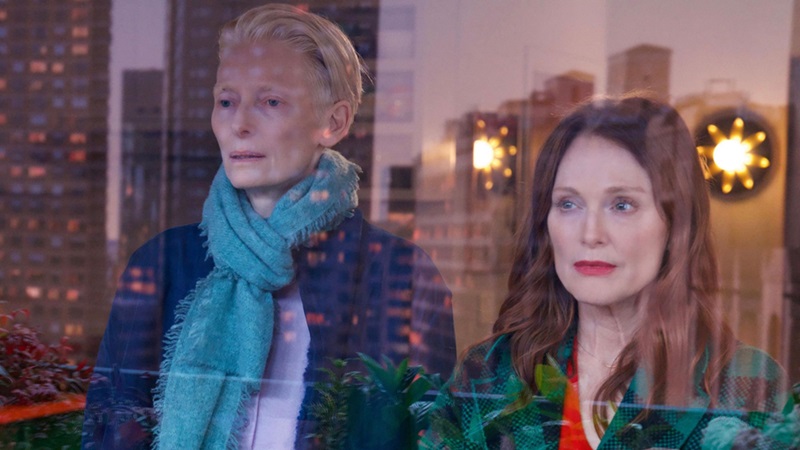
The Room Next Door se concentra nos diálogos entre Martha (Tilda Swinton) e Ingrid (Julianne Moore) e acerta ao deixar de lado fatos, revelações ou reviravoltas. A embalagem palavrosa é um acerto na medida em que o filme tem ambições muito simples, como a de se concentrar na relação entre essas duas mulheres que, um dia colegas de profissão, voltam a se aproximam em função do câncer terminal de uma delas. O texto coloca o espectador cúmplice dessa vida repentina agora compartilhada pelas duas — para além do apoio mútuo e das cumplicidades femininas, Martha e Ingrid meditam sobre o que significa viver e morrer de verdade, sem, claro, vertentes de autoajuda, já que se trata de Pedro Almodóvar, mesmo que em outra língua.
A melancólica atmosfera disfarça certas fragilidades, como o dispensável uso de determinados flashbacks para ilustrar a vida pregressa de Martha, quando, na realidade, a narração da própria personagem já é suficiente. Outro aspecto que não chega a estar devidamente lapidado é o quanto sabemos muito mais sobre uma personagem do que sobre outra. Ficam algumas lacunas na história de Ingrid — afinal, quais foram as suas reais motivações para escrever um livro sobre morte e por que esse tema é um assunto tão delicado para a personagem. São questões que The Room Next Door mais insinua do que responde, o que, nesse caso, é um demérito.
Lindamente fotografadas por Eduard Grau, seja com os flocos de neve nova-iorquinos ou com as paisagens idílicas de uma casa afastada da vida urbana, Tilda Swinton e Julianne Moore preenchem a tela com seus talentos habituais e toda a pompa necessária para serem duas chicas de Almodóvar. O encontro entre as duas, que atuam pela primeira vez juntas, é o tipo de acontecimento que um cineasta como ele merecia em uma estreia hollywoodiana. The Room Next Door não é exatamente um grande longa do cineasta, mas se encaixa muito nessa sua fase mais sensível e atenta à finitude da vida e o que fizemos dela, já vista no excepcional Dor e Glória.
THE ROOM NEXT DOOR REVIEW
Debuting in Hollywood is an almost natural path for non-English-speaking directors who gain worldwide recognition with films made in their home countries. Pedro Almodóvar, who already has two Oscars for All About My Mother and Talk to Her, resisted this trend for quite some time. He also took his time: first, he was set to have Meryl Streep star in his Julieta, and later, after years, began planning A Manual for Cleaning Women with Cate Blanchett. For different reasons, both projects did not move forward as his first English-language feature.
Instead, Almodóvar chose a gentler path: he began filming in Hollywood with two restrained short films. The first, The Human Voice, was shot with Tilda Swinton during the pandemic, while Strange Way of Life featured Ethan Hawke and Paul Mescal in a gay western. In both cases, the results did not ignite much excitement. Perhaps this was due to the abrupt halt of stories that deserved a longer narrative. Or maybe it was due to Pedro’s evident effort to “translate” his style and language into a different universe. Finally, his first English-language feature happens: The Room Next Door, an adaptation of the book What Are You Going Through by Sigrid Nunez, with Tilda Swinton and Julianne Moore in the lead roles.
The time Almodóvar gave himself in the quest for his first big Hollywood debut shows on screen, as The Room Next Door reveals a filmmaker visibly comfortable with the change of setting. It’s not just a matter of transposing Almodóvar’s classic elements – his colors, Alberto Iglesias’ soundtrack, the melodrama – into another language. The film also delves into a respectful and human discussion of a complicated topic like euthanasia, highlights the director’s fondness for working with great actresses, and, more than anything, preserves his essence as a storyteller in both style and narrative, without conforming to another industry’s standards.
The Room Next Door focuses on the dialogues between Martha (Tilda Swinton) and Ingrid (Julianne Moore), and it succeeds by steering away from plot twists or big revelations. The film’s word-heavy approach is a strength because it has very simple ambitions: to concentrate on the relationship between these two women who, once colleagues, reconnect due to one of them facing terminal cancer. The script makes the audience a silent witness to this suddenly shared life – beyond mutual support and feminine camaraderie, Martha and Ingrid reflect on what it truly means to live and die, without delving into self-help clichés, as this is, after all, Pedro Almodóvar, even in a different language.
The melancholic atmosphere disguises certain weaknesses, such as the unnecessary use of some flashbacks to illustrate Martha’s past, when, in fact, the character’s own narration is sufficient. Another aspect that doesn’t feel fully developed is how we end up knowing much more about one character than the other. There are some gaps in Ingrid’s story – after all, what were her real motivations for writing a book about death, and why is this theme such a delicate subject for her? These are questions that The Room Next Door hints at more than it answers, which in this case is a shortcoming.
Beautifully shot by Eduard Grau, whether it’s the New York snowflakes or the idyllic landscapes of a house far from urban life, Tilda Swinton and Julianne Moore fill the screen with their usual talent and all the poise necessary to be Almodóvar’s leading ladies. The meeting of these two actresses, working together for the first time, is the kind of event a filmmaker like Almodóvar deserved for his Hollywood debut. The Room Next Door may not be one of the director’s great films, but it fits well within his more sensitive phase, focused on life’s finitude and what we make of it, as seen in the exceptional Pain and Glory.
TIFF 2024, #2: “Ainda Estou Aqui”, de Walter Salles

O editor do jornal pediu, mas Eunice Paiva, a protagonista de Ainda Estou Aqui, não cedeu. A foto que ela está prestes a tirar com a família para publicação será, sim, com todos sorrindo, sem sinais de tristeza. Trata-se de um momento emblemático no filme de Walter Salles, pois sintetiza não apenas a essência de uma grande mulher, mas também a de um filme muito parecido com ela, que viu o marido ser levado para interrogatório durante a ditadura militar brasileira e, sem nunca mais encontrá-lo, precisa reinventar a família e a si própria.
A personagem existiu de verdade, e a sua história de vida ainda estava por ser descoberta — Eunice é mãe do escritor Marcelo Rubens Paiva, autor do livro que dá origem ao longa, e do célebre Feliz Ano Velho. Dona de casa da burguesia carioca, ela se transforma completamente após perder o marido duas vezes: primeiro, com sua ausência dentro de casa, quando ele é levado por milicos; e, depois, com a sua morte, oficialmente reconhecida apenas muitos anos depois pelo Estado brasileiro.
Walter Salles, que realiza seu primeiro longa após mais de uma década, já parte com uma vantagem ao contar a história de Eunice em si, abordando-a de maneira cuidadosa e sensível. A partir do roteiro escrito por Heitor Lorega e Murilo Hauser, ele evita ao máximo a exploração de emoções em momentos-chave da trama. O choro que a protagonista esconde e a sua constante determinação em preservar os filhos, custe o que custar, funcionam muito mais do que a mera exposição, colocando o espectador na mesma posição ao testemunhar os fatos — o que, dramaticamente, cria um efeito cumulativo e melancólico.
Ainda Estou Aqui revela Eunice como uma mulher à frente de seu tempo. Além de segurar sozinha a barra de criar a família após o desaparecimento do marido, ela decide cursar Direito para, dessa forma, exigir pessoalmente das autoridades brasileiras o reconhecimento da morte não decretada do esposo — um arquiteto e ex-deputado que, apesar da ausência física, ficou vivo na memória de Eunice até os seus últimos dias de vida, em dezembro de 2018, quando faleceu após quase 15 anos convivendo com o mal de Alzheimer.
Concentrando o capítulo específico da História de um país na trajetória de uma única mulher, Ainda Estou Aqui se esquiva dos didatismos de uma temática já deveras explorada pelo cinema brasileiro. Não por acaso, ao apostar nessa perspectiva “individualizada”, o filme se torna universal, identificável e ainda mais próximo ao espectador. A narrativa segue um estilo bastante clássico, com as devidas contextualizações, mas o coração de Ainda Estou Aqui está no cotidiano e no silêncio de incontáveis pessoas que foram torturadas pela ditadura de outra forma: condenadas ao convívio diário com lacunas e perguntas nunca respondidas.
Fernanda Torres, no papel de Eunice Paiva, é um espetáculo de sutileza, força e sobriedade. E aqui reservo um tempo para falar especificamente sobre seu trabalho porque Ainda Estou Aqui é o retorno que ela merecia após tantos anos sem participar de um longa de ficção (os dois últimos foram em 2009: A Mulher Invisível e Os Normais 2). Proporcional em economia e emoção, é uma interpretação que nos remete a outros grandes momentos de sua carreira no cinema, principalmente entre os anos 1980 e 1990, quando brilhou em filmes como A Marvada Carne, Terra Estrangeira, Eu Sei Que Vou Te Amar e Com Licença, Eu Vou à Luta.
E, se comentei sobre o quanto Ainda Estou Aqui suprime emoções para, de certo modo, reproduzir o próprio estado interno da protagonista, a situação muda inevitavelmente no terço final da trama, quando Eunice recebe a oficialização pela qual tanto lutou (“é esquisito, sentir alívio com um atestado de óbito”, diz ela). Já enfrentando o mal de Azheimer, e interpretada pela incomparável Fernanda Montenegro, em aparição poderosa, Eunice vê como o tempo atuou sobre a sua família e percebe que, por mais que o passado esteja “resolvido’, ele sempre estará presente.
O fato de Ainda Estou Aqui chegar aos cinemas em 2024 também carrega um gosto melancólico, pois se torna um importante lembrete dos horrores que vivemos nesse período sombrio da trajetória brasileira. Em um país que, nos últimos anos, pareceu esquecer e até glorificar a ditadura, em uma perigosa manobra política de massa, o filme é mais do que um poderoso antídoto. Assim como em Central do Brasil, Walter Salles lança um olhar atemporal sobre o que constitui o Brasil. Que ele não demore tanto para nos brindar novamente com obras de tamanha potência.
I’M STILL HERE REVIEW
The newspaper editor asked, but Eunice Paiva, the protagonist of I’m Still Here, did not comply. The family photo she is about to take for publication will indeed be with everyone smiling, without sadness. This moment is emblematic in Walter Salles’ film because it summarizes not only the essence of a great woman but also of a film very similar to her – a woman who saw her husband taken for interrogation during Brazil’s military dictatorship and, never seeing him again, had to reinvent her family and herself.
The character really existed — she is the mother of writer Marcelo Rubens Paiva, author of the book that inspired the film, and of the famous Happy Old Year. Her life story was still waiting to be discovered. Being a bourgeois housewife from Rio de Janeiro, she is completely transformed when she loses her husband twice: first, with his absence from home after being taken by the military; and later, with his death, officially recognized many years later by the Brazilian government.
Walter Salles, making his first feature film in over a decade, starts off strong with Eunice’s story alone and with the way he chooses to tell it. Based on the script written by Heitor Lorega and Murilo Hauser, he minimizes emotional exploitation in the key moments of the plot. The tears Eunice hides and her constant decision to protect her children at all costs work much better than mere emotional display, putting the audience in the same position of witnessing the facts. Dramatically, this creates a cumulative and melancholic effect.
I’m Still Here understands the forward-thinking woman that Eunice was. In addition to single-handedly bearing the burden of raising her family after her husband’s disappearance, she decides to study law so she can personally demand from the Brazilian authorities the recognition of her husband’s undeclared death – an architect and former congressman who, despite being physically absent, remained alive in Eunice’s memory until her last days in December 2018, when she passed away after living nearly 15 years with Alzheimer’s disease.
By focusing on a specific chapter of a country’s history through the life of one woman, I’m Still Here avoids the didacticism of a subject already extensively explored by Brazilian cinema. It’s no coincidence that, by getting on this “individualization”, the film becomes universal, relatable, and even closer to the viewer. The narrative follows a classic style, and the necessary contextualization is made, but the heart of I’m Still Here lies in the everyday lives and hearts of countless people who were tortured by the dictatorship in another way – condemned to live daily with absence, and the lack of answers.
Like Eunice Paiva, Fernanda Torres delivers a spectacular performance of subtlety, strength, and restraint. Here, I take a moment to specifically talk about her because I’m Still Here is the comeback she deserved after so many years without participating in a fiction feature (her last two were in 2009: The Invisible Woman and So Normal 2: The Craziest Night Ever). Her new role, balanced in economy and emotion, reminds us of the many grand performances that have marked her career, especially in the 1980s and 1990s, when she shone in films like That Damned Meat, Foreign Land, Love Me Forever or Never and Com Licença, Eu Vou à Luta.
And while I mentioned how I’m Still Here suppresses emotions to, in a way, reflect the protagonist’s inner state, this inevitably changes in the final third of the film. Eunice finally receives she fought so hard for (“it’s strange to feel relief with a death certificate”, she says), and as she faces Alzheimer’s and is portrayed by the incomparable Fernanda Montenegro in a powerful appearance, she sees how time has impacted her family and how the past, no matter how resolved, will always remain present.
The fact that I’m Still Here arrives in theaters in 2024 also carries a melancholic tone, as it serves as an important reminder of the horrors experienced during a dark chapter in Brazilian history. For a country that, in recent years, has forgotten and even glorified the dictatorship in a dangerous political mass maneuver, this is more than powerful. Just as he did in Central Station, Walter Salles casts a timeless gaze on what defines Brazil. Let’s hope it won’t take him as long to bring us more works of this magnitude.
 Cinema e Argumento