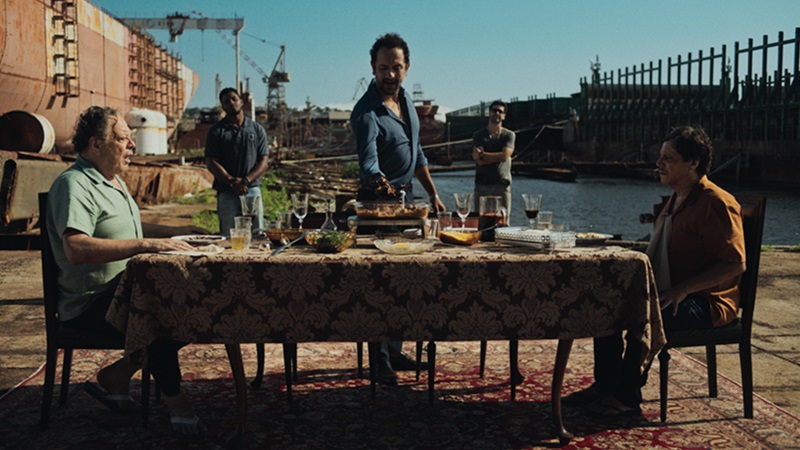
Mais de dez anos após o impactante O Lobo Atrás da Porta, pelo qual concorreu ao Directors Guild Awards de melhor longa-metragem de estreia, Fernando Coimbra está de volta com Os Enforcados, filme estrelado por Irandhir Santos e Leandra Leal que estreia mundialmente no TIFF 2024. A brutalidade volta a ser uma questão importante Coimbra, dessa vez na zona leste do Rio de Janeiro, tendo como pano de fundo a criminalidade do jogo do bicho e uma paranoia matrimonial que leva os protagonistas para uma espiral de impulsos, equívocos e violência. Diretamente do TIFF, conversei com o diretor e os atores Thiago Thomé e Pêpê Rapazote sobre os temas abarcacados em Os Enforcados e como o filme dialoga com a realidade brasileira e o próprio cinema de Coimbra. Confiram abaixo!
Fernando, sobre esse filme ser uma mistura de Macbeth com os irmãos Coen… Acho que ele será bastante interpretado dessa maneira. É uma definição que te agrada?
FERNANDO – Eu vendi um pouco o projeto desse jeito. Quando a gente começou a levar o roteiro pra fora, atrás de produção, foi assim: um Macbeth, inspirado nos irmãos Coen, com direção de um sul-coreano, passado no Brasil. Pra dar uma ideia do tom. [risos]
PÊPÊ – Aliás, a tradução quase foi No Country for Bicheiro, né? [risos]
FERNANDO – Tem uma inspiração de Fargo no roteiro, sim. Aquela ideia de “vamos cometer um crime, sequestrar alguém, pegar o dinheiro, ninguém se machuca e tudo vai dar certo”. Mas nada na vida real é o que se espera, né? A loucura das pessoas leva tudo para outro lugar.
O Lobo Atrás da Porta [primeiro longa dirigido por Fernando] abordava uma parte mais urbana do Rio de Janeiro. Agora, pelo que você falou ontem na sessão, a ideia foi pegar um outro lado do Rio de Janeiro. Essa “abrasileirada” da trama veio antes ou depois da ideia de misturar Macbeth com os irmãos Coen?
FERNANDO – Eu tinha mesmo a ideia de olhar para aquele lugar da Barra da Tijuca, zona oeste… É uma coisa que a gente não vê muito no cinema. O Lobo já foi um subúrbio do Rio, mas que não era a comunidade, não era a favela, também não era a Zona Sul.
THIAGO – A maior parte da população do Rio tá ali na zona norte
FERNANDO – Sim, e não se mostra tanto isso. E, quando mostra, tem um crime, envolve tráfico. Eu passava pela Barra, indo para algumas locações, e via que era um lugar a ser estudado. E aí eu tinha a ideia dessa história da máquina com a lei, jogo do bicho. Queria que os personagens estivessem inseridos em um universo criminoso. Criminoso, mas aceito. Até porque as pessoas estão tomando consciência do jogo do bicho só agora. Sabem que é uma contravenção, mas, na cabeça delas, não é um crime.
Pois eu ia perguntar especificamente sobre o jogo do bicho. O cinema brasileiro já falou muito sobre essas questões de criminalidade no Rio de Janeiro, mas você mesmo comentou que o jogo do bicho é uma coisa que ainda não tinha sido muito explorada. Isso passo um pouco por essa “ingenuidade” que é só um joguinho?
FERNANDO – Olha, é difícil dizer, mas eu acho que tem uma coisa muito folclórica do bicheiro, algo meio mitológico. E é, né? Eu cresci vendo o Castor de Andrade que parecia um personagem do Chico Anísio e que estava em todos os lugares. A presença do bicheiro foi completamente normalizada. É um jogo que nunca foi visto muito popularmente como um crime. Como esses caras ainda tem muita ligação com o poder, as coisas também ficam mais em evidência.
Tem, inclusive, aquela entrevista com o Zeca Pagodinho em que perguntam se ele é favor da legalização do jogo do bicho e ele diz: “mas é ilegal?”.
THIAGO – Eu, que cresci no subúrbio do Rio de Janeiro, lembro da minha avó que morava no Irajá. Ela fazia o jogo e dava pra gente ir lá levar no bicheiro. É muito cultural. E essa ligação com a escola de samba… A gente cresce já entendendo esse lugar. Então, faz parte. Tanto que essa fala do Zeca, não é uma parada que ele fala como comédia. É real. Ele fala com muita naturalidade. O que pode e o que não pode tem um limiar muito fino no Brasil. Algumas coisas não podem, mas são aceitas. Outras podem, mas não é legal fazer. A gente fica sempre nessa dicotomia do que pode ser feito e do que não pode. O jogo do bicho entra muito nesse lugar. Qualquer morador do subúrbio do Rio de Janeiro sabe onde estão os pontos pra jogar: na barbearia, no bar… A gente cresce sabendo. Claro, depois que você vai tomando consciência, você sabe que não é legal. E, aí, você faz a escolha de jogar ou não.
FERNANDO – É, mas eu moro em São Paulo, em Perdizes, e tem dois pontos do bicho perto da minha casa. Não é só no Rio.
Fernando, você mencionou a brutalidade que está envolvida em tudo isso. Nos teus dois filmes, tanto no Lobo, quando agora em Os Enforcados, a brutalidade está mesmo muito presente. Isso é coincidência ou é de fato um interesse do teu cinema?
FERNANDO – Não é coincidência, não. É realmente um interesse. Eu acho o ser humano muito brutal. Se você olhar para o que acontece em Israel, Gaza, Palestina, Rússia, Ucrânia, Estados Unidos… Mas é violência em vários níveis, desde as relações familiares mais básicas, que são agressivas e invasivas, chegando até vários níveis sociais. O ser humano é um bicho.
Era isso que eu ia mencionar. No filme, tem também a brutalidade psicológica e emocional entre aquele casal, e vocês dois [Thiago e Pêpê] estão no meio do fogo cruzado. Vocês exercem um papel muito importante ali nessa dinâmica de que “o que os olhos não veem, a paranoia inventa”.
PÊPÊ – Você tem razão. O que os olhos não veem, a paranoia inventa. Fica a sugestão, sobretudo quando você já está desconfiado. Qualquer sinal já entra na paranoia. E eu acho que o papel do Thiago e do Delegado Torres [papel de Pêpê] são os contrapontos que permitem a subida vertiginosa da paranoia, da esquizofrenia desse casal, diante da falta de comunicação, de uma separação.
THIAGO – Acho que, no caso do Jobson [papel de Thiago], viver ali com aquela família acaba fazendo ele entender, pensar que “faz parte”. E a gente vive isso na nossa vida. Tem coisas que eu vou olhar na sua vida e falar assim: meu Deus, como é que você faz isso? E, aí, você vai olhar pra mim e falar a mesma coisa. A gente aceita porque é uma intimidade. Cada um vai ter um ponto de vista. Acho que, nesse sentido, o Jobson não julga. Ele sabe, ele vê, mas não vai julgar, porque ele vive com esse cara [o personagem de Irandhir Santos] desde sempre. Ele olha aquilo e fala: faz parte da família.
PÊPÊ – E, no caso do Delegado Torres, ele está habituado a muita coisa. Só quer descortinar.
FERNANDO – É um filme sobre um casamento. E o casamento é um pacto. Um pacto de vida. E um plano. No começo você fala: vamos casar, ter filhos, uma casa no campo. E, ali, é meio isso, mas num lado mais alegórico: o crime é o plano. E é uma coisa simples. Descrição de Fargo, né? Como em muitos casamentos e em muitas relações, de repente, eles começam a não querer compartilhar, ele vai se empoderando…
PÊPÊ – A paranoia inventando coisa, né? Ele já não precisa tanto dela, vai perdendo as rédeas um pouco. Ela não se sente cúmplice, mas, sim, secundária em um determinado momento. E o Delegado Torres é como um amante, aquela terceira pessoa que, quando a relação não está bem, chega e fala: “vem cá, tem uma vida melhor te esperando”. Tinha que ser uma coisa meio assim. E acaba sendo outra fantasia criada: a de sair da relação e ter outra pessoa trazendo um caminho melhor, de salvação. Acho que a ideia era trabalhar muito nessa coisa que eu acho que corresponde em todo mundo: as relações humanas.
Pegando o gancho dessa discussão, quero entrar na questão do tom propriamente dito do filme. É uma mistura de thriller, comédia, drama… E é claro que um diretor vai trabalhando para que todas as peças de encaixem, mas, no caso de um projeto que mistura várias coisas como Os Enforcados, a gente só vai saber mesmo se todas as peças se encaixaram no final, quando o filme fica pronto e chega ao público. Como foi para você, Fernando? Isso de alguma forma te intimidou? Ou foi algo estimulante?
FERNANDO – Intimidou, mas, na verdade, foi me colocando em um lugar totalmente fora da zona de conforto de tudo que eu vinha fazendo. Eu queria que o filme tivesse essa coisa meio pesadelo, meio alegórica também, no jeito de contar. Então, não é naturalista como o Lobo era. Não me intimidou. Me deu foi muita coragem de fazer. Mas é bem o que você falou: fica esse mistério.
THIAGO – As transformações estavam muito bem pontuadas para simplesmente não perdermos a linha. Tem uma coisa também da construção desses personagens que o Fernando criou. Nós, como atores e atrizes, também precisamos conceber e passar a credibilidade de que são humanos. Eles podem ter esses vários planetas dentro do mesmo universo. E o Fernando consegue escrever isso de uma forma brilhante, dando essa liberdade para sermos o que somos mesmo. O filme trata isso muito bem. Tanto que as pessoas riram, aplaudiram.
E a risada, no fundo, sempre esconde uma coisa na qual as pessoas se reconhecem, né?
PÊPÊ –Total. Eu brinco com o Fernando que esse filme é uma forma de jogar para fora o psicopata que fica aí dentro. Esse filme só existe porque o Fernando não está preso. [risos] A reação de risada é a mesma coisa. É rir de uma coisa que estava querendo rir faz tempo. Com relação ao tom que a gente estava falando, tem também essa saída e entrada do pesadelo, com personagens sempre se puxando pra um lado e pro outro. E isso, pra mim, era no início: “caramba, que insegurança que é essa? Onde que eu estou?”. O meu sofrimento só era apaziguado pelo sofrimento do Fernando. Se eu estava assim, imagina o Fernando que pensava em todas as personagens? Tinha tudo isso, mas ficou no ponto certo, equilibrado. Parece um milagre, só que não é um milagre. Tem muita sabedoria.
E trabalharam bastante pra isso. [risos]
THIAGO – Uma coisa boa de pontuar, só pra poder finalizar, é a leveza que foi construir esse filme. O set, a liberdade que o Fernando deu pra gente atuar. Quando a direção escolhe um elenco, dá pra entender que ele escolheu aquele ator, aquela atriz, para aquele papel. Ela sabe da competência daquela pessoa. E o Fernando não é um diretor que interfere tanto, sabe? Ele diz: vai lá e faz. Isso torna o set leve, e um set leve faz um filme ficar brilhante. Ajuda muito. Pra não ficar todo mundo…
Na paranoia dos personagens? Fazer a coisa mais leve.
THIAGO – Isso.
Os Enforcados abre a Première Brasil do Festival do Rio no dia 4 de outubro e tem estreia programada no circuito comercial brasileiro para o dia 21 de novembro.
CARNIVAL IS OVER: INTERVIEW WITH DIRECTOR FERNANDO COIMBRA AND ACTORS THIAGO THOMÉ AND PÊPÊ RAPAZOTE
More than ten years after A Wolf at the Door, for which he competed for the Directors Guild Awards for best debut feature film, Fernando Coimbra is back with Carnival is Over, a film starring Irandhir Santos and Leandra Leal that has its world premiere at TIFF 2024. Brutality once again becomes an important issue in Coimbra, this time in the east zone of Rio de Janeiro, discussing the criminality of Jogo do Bicho and a marital paranoia that leads the protagonists into a spiral of impulses, mistakes and violence . Directly from TIFF, I spoke with the director and actors Thiago Thomé and Pêpê Rapazote about how the film dialogues with brazilian reality and Coimbra’s own cinema. Check it out below!
Fernando, regarding this film being a mix of Macbeth and the Coen brothers… I think it will be interpreted that way quite a bit. Does that definition appeal to you?
FERNANDO – I kind of sold the project that way. When we started pitching the script, looking for production, it went like this: a Macbeth inspired by the Coen brothers, directed by a South Korean, set in Brazil. To give an idea of the tone. [laughs]
PÊPÊ – By the way, the translation almost became No Country for Bicheiro, right? [laughs]
FERNANDO – There’s definitely some Fargo inspiration in the script. That idea of “let’s commit a crime, kidnap someone, get the money, no one gets hurt, and everything will work out.” But in real life, nothing ever goes as expected, right? People’s madness takes things in a completely different direction.
In A Wolf at the Door [Fernando’s first feature film], you explored a more urban side of Rio de Janeiro. Now, from what you mentioned in the screening, the idea was to explore a different side of the city. Did this ‘Brazilianization’ of the plot come before or after the idea of mixing Macbeth with the Coen brothers?
FERNANDO – I already had the idea to focus on that area of Barra da Tijuca, in the west zone. It’s something we don’t see much in cinema. A Wolf dealt with a Rio suburb that wasn’t the favela, and wasn’t the rich South Area either.
THIAGO – Most of Rio’s population is in the North Area.
FERNANDO – Yes, and we don’t see that portrayed much. And when it is shown, it often involves crime or drug trafficking. I used to pass through Barra on the way to some locations, and I felt it was a place that deserved to be explored. Then I had the idea of blending this with the story of the illegal gambling known as jogo do bicho. I wanted the characters to be part of a criminal universe. Criminal, but accepted. After all, people are only now realizing that jogo do bicho is an infraction. They know it’s illegal, but in their minds, it’s not really a crime.
I was going to ask specifically about jogo do bicho. Brazilian cinema has addressed criminality in Rio quite a bit, but you mentioned that jogo do bicho is something that hasn’t been widely explored yet. Does that reflect this “innocence” of it just being a little game?
FERNANDO – Well, it’s hard to say, but there is definitely something folkloric about the bicheiro (the person who runs the jogo do bicho), something almost mythical. I grew up seeing Castor de Andrade, who looked like Chico Anysio and who was everywhere. The presence of the bicheiro has been completely normalized. It’s a game that’s never really been seen as a crime by the general public. And since these guys have strong connections with power, it puts things more in the spotlight.
There’s even that interview with Zeca Pagodinho [brazilian singer] where they ask if he’s in favor of legalizing jogo do bicho, and he replies, “but it’s illegal?”
THIAGO – I grew up in the suburbs of Rio, in Irajá. My grandmother used to place bets, and we’d go deliver them to the bicheiro. It’s deeply ingrained in the culture. And the connection with samba schools… We grow up understanding this. So it’s just part of life. Zeca’s statement wasn’t a joke; it was real. He spoke with complete sincerity. In Brazil, there’s a fine line between what’s allowed and what isn’t. Some things are technically illegal but accepted, while others are legal but frowned upon. Jogo do bicho fits perfectly into that gray area. Every resident of the Rio suburbs knows where to place their bets – at the barbershop, at the local bar. We grow up knowing it’s not exactly lawful, but we make a choice to participate or not.
FERNANDO – I live in São Paulo, in Perdizes, and there are two jogo do bicho spots near my house. It’s not just in Rio.
Fernando, you mentioned the brutality involved in all of this. In both of your films, A Wolf at the Door and now Carnival Is Over, brutality is very present. Is that a coincidence or something you’re genuinely interested in exploring in your films?
FERNANDO – It’s not a coincidence. It’s something I’m very interested in. I think human beings are inherently brutal. If you look at what’s happening in Israel, Gaza, Palestine, Russia, Ukraine, the U.S. – violence exists on so many levels. It ranges from the most basic, aggressive family dynamic to large-scale societal violence. Human beings are like animals.
That’s what I was going to bring up. In the film, there’s also this psychological and emotional brutality between the couple, and you two [Thiago and Pêpê] are caught in the middle of that crossfire. Your roles are crucial in creating this dynamic where “what the eyes don’t see, paranoia invents.”
PÊPÊ – You’re right. What the eyes don’t see, paranoia invents. Once you’re suspicious, any little sign feeds into it. I think Thiago’s and my characters serve as the counterpoints that allow the couple’s paranoia and schizophrenia to escalate due to their lack of communication and separation.
THIAGO – In Jobson’s case, living with that family makes him think, “this is just part of it.” We experience that in our own lives. There are things I might see in your life and think, “How do you do that?” And you might look at me and wonder the same. We accept things because of intimacy. Everyone has a different perspective. So, in that sense, Jobson doesn’t judge. He knows, he sees, but he doesn’t judge, because he’s been with this guy [Irandhir Santos’ character] forever. To him, it’s just part of the family.
PÊPÊ – In the case of my character, Detective Torres, he’s used to seeing everything. He just wants to uncover the truth.
FERNANDO – It’s a film about marriage. And marriage is a pact. A life pact. And a plan. In the beginning, you say “we’ll get married, have kids, a house in the countryside.” And here, it’s kind of like that, but in a more allegorical way: the crime is the plan. And it’s a simple thing. Like in Fargo, right? Like in many marriages and relationships, suddenly, they don’t want to share anymore, and he starts feeling more empowered…
PÊPÊ – The paranoia inventing things, right? He doesn’t need her as much anymore, he’s losing control a bit. She doesn’t feel like a partner, but rather secondary at some point. And Detective Torres is like a lover, that third person who, when the relationship isn’t going well, comes along and says, “come here, there’s a better life waiting for you.” It had to be something like that. And then it becomes another fantasy: the fantasy of leaving the relationship and having someone else bring a better path, a way to salvation. I think the idea was to really explore something I think applies to everyone: human relationships.
Taking a cue from the discussion, I want to talk about the film’s tone. It’s a mix of thriller, comedy, drama… And of course, a director works to make sure all the pieces fit together, but with a project that mixes so many elements like Carnival Is Over, we only know for sure if the pieces fit once the film is done and reaches the audience. How was that for you, Fernando? Did it intimidate you in any way? Or was it exciting?
FERNANDO – It intimidated me, but it also put me completely out of my comfort zone from everything I’d be doing. I wanted the film to have this kind of nightmare-like quality, a bit allegorical in the way it’s told. So it’s not as naturalistic as Wolf was. It didn’t intimidate me. It actually gave me the courage to do it. But as you said, there’s still that mystery.
THIAGO – The transformations were really well defined so we wouldn’t lose track. There’s also something about the construction of these characters that Fernando created. As actors, we also need to conceive and convey the believability that they are human. They can have different “planets” within the same universe. And Fernando writes this in a brilliant way, giving us the freedom to be who we are. The film handles that very well. People laughed, they clapped.
And laughter, deep down, always hides something that people recognize in themselves, right?
PÊPÊ – Totally. I joke with Fernando that this film is a way of letting out the psychopath that’s inside us. This film only exists because Fernando isn’t in jail. [laughs] Laughter is the same thing. It’s laughing at something you’ve wanted to laugh about for a long time. Regarding the tone we were talking about, there’s also this constant entering and exiting of the nightmare, with characters always pulling each other in different directions. For me, at first, it was like, “Wow, what’s this insecurity? Where am I?” My suffering was only eased by Fernando’s suffering. If I was feeling this way, imagine Fernando, who had to think about all the characters! There was all that, but it hit the right note, perfectly balanced. It seems like a miracle, but it’s not a miracle. It’s a lot of wisdom.
And a lot of hard work went into that. [laughs]
THIAGO – One good point to highlight, just to wrap up, is how light the process of making this film was. The set, the freedom Fernando gave us to act. When a director picks a cast, it’s clear that he chose that actor, that actress, for that role. He knows the competence of that person. And Fernando isn’t a director who interferes a lot, you know? He says, “go ahead, do it.” That makes the set light, and a light set makes a brilliant film. It helps a lot. So everyone isn’t stuck…
In the paranoia of the characters? To make things lighter.
THIAGO – Exactly.
 Cinema e Argumento